
Inside the Gas Giant’s Mysterious Interior and What NASA’s Data Reveals
Thank you for reading this post, don’t forget to subscribe!Why It Matters
- Understanding Jupiter’s core helps scientists explain how gas giants form across the universe.
- The structure of its interior influences its magnetic field, gravity, and long-term stability.
- Insights from Jupiter reshape how astronomers interpret massive exoplanets orbiting distant stars.
Jupiter dominates the Solar System in both size and gravitational influence. With a mass more than twice that of all the other planets combined, it has shaped the architecture of our planetary neighborhood since its formation over 4.5 billion years ago. Yet despite its enormous presence, one of the most fundamental questions about Jupiter remains unresolved: what does its core actually look like?

Image Credit: Jupiter illustration by AdisResic via Pixabay.
Unlike Earth, Jupiter has no solid surface where instruments can land and drill downward. Everything known about its interior comes from indirect measurements, theoretical modeling, and high-precision spacecraft data. Over time, those measurements have forced scientists to rethink earlier assumptions and replace simple models with far more complex ones.
The Traditional View of Jupiter’s Core
For decades, planetary scientists believed Jupiter formed through a process known as core accretion. In this model, a dense rocky core formed first from colliding planetesimals in the early Solar System. Once that core reached a critical mass, it rapidly attracted hydrogen and helium gas from the surrounding nebula.

Under this framework, Jupiter’s core was expected to be compact, solid, and heavy. Estimates suggested a central mass roughly 5 to 15 times the mass of Earth composed primarily of rock, metal, and frozen volatiles. The core would have acted as the gravitational anchor around which the planet’s massive atmosphere accumulated.
New Data from Juno
The arrival of Juno at Jupiter in 2016 changed the scientific conversation dramatically. Rather than studying the planet from a distant orbit, Juno follows elongated polar passes that allow it to measure Jupiter’s gravitational field with extraordinary precision. Subtle variations in gravity reveal how mass is distributed inside the planet.

Image Credit: NASA/JPL-Caltech/SwRI/MSSS/Betsy Asher Hall/Gervasio Robles
The results surprised researchers. Instead of confirming a small, sharply defined rocky core, Juno’s data suggested something far more diffuse. The interior appears to contain a large region enriched with heavy elements that extends much farther outward than previously believed.
The Concept of a “Fuzzy” Core
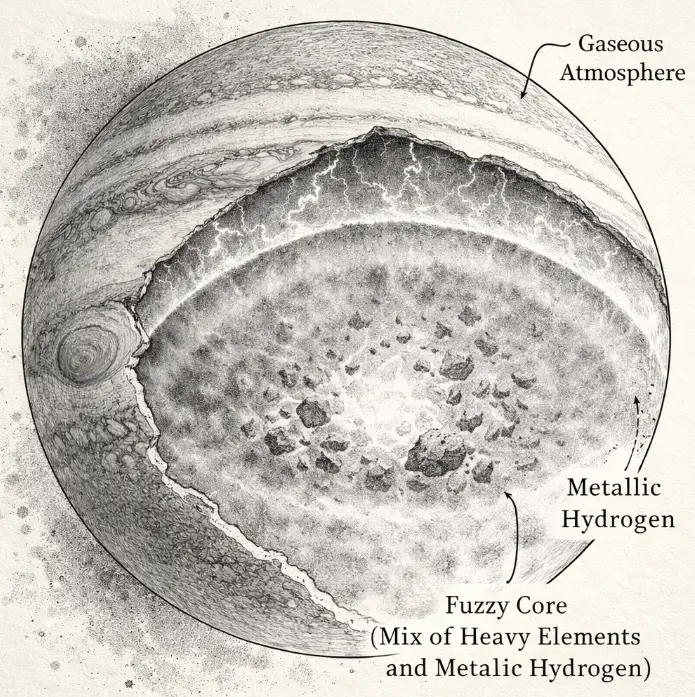
The term “fuzzy core” emerged to describe this new understanding. Rather than a clearly bounded sphere of rock and metal at the center, Jupiter may have a diluted region where heavy materials are partially mixed with hydrogen and helium. In this structure, there is no clean boundary between core and envelope.

This diluted core could extend across a substantial fraction of Jupiter’s radius. Heavy elements appear to be gradually blended into surrounding layers instead of confined to a compact central mass. The result is less like a solid marble at the center and more like a dense gradient transitioning into metallic hydrogen.
Extreme Pressure and Exotic Matter
Jupiter is composed mostly of hydrogen and helium, but conditions deep inside are anything but ordinary. Pressures near the center exceed tens of millions of times Earth’s atmospheric pressure. Temperatures are estimated to reach roughly 20,000 to 35,000 degrees Fahrenheit.
Under these conditions, hydrogen behaves in unusual ways. It transitions into metallic hydrogen, a state in which it conducts electricity like a metal rather than behaving as a typical gas. This metallic hydrogen layer plays a central role in generating Jupiter’s powerful magnetic field, one of the strongest planetary magnetic fields in the Solar System.

Image Credit: NASA/JPL-Caltech/SwRI/MSSS; Kevin M. Gill (CC BY)**
In such extreme environments, traditional categories like solid, liquid, and gas begin to blur. The materials at Jupiter’s center may not resemble solid rock in any familiar sense. Instead, the core region likely consists of compressed heavy elements dissolved or partially mixed within metallic hydrogen.
Did a Giant Impact Reshape the Core?
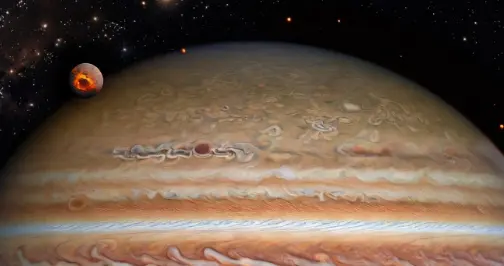
One compelling hypothesis proposes that Jupiter may not have always had a diluted core. Some researchers suggest that after forming an initial dense core, the young planet could have experienced a collision with a large planetary embryo. Such an impact would have injected tremendous energy into the interior.

A collision of this magnitude could have disrupted and partially dissolved the original core. Heavy elements may have been mixed upward, creating the extended, fuzzy structure detected by Juno. This scenario aligns with models showing that giant impacts were common during the chaotic early stages of planetary formation.
Comparisons with Saturn
Jupiter is not alone in displaying a complex interior. Recent gravitational studies of Saturn also suggest the presence of a diffuse core rather than a compact solid center. If both gas giants share this feature, fuzzy cores may be a common outcome of giant planet formation.

This realization has implications far beyond our Solar System. Astronomers have identified thousands of gas giant exoplanets orbiting distant stars. Understanding Jupiter’s interior provides a template for interpreting those worlds, especially when only mass and radius measurements are available.
What Jupiter’s Core Likely Looks Like
Jupiter’s core likely appears as a vast, dense region of heavy elements gradually blending into surrounding metallic hydrogen. It is not a sharply defined rocky ball, nor is it empty space beneath the clouds. Instead, it is a compressed, mixed, and extreme environment shaped by gravity and possibly by ancient collisions.
The image of a simple solid center has given way to a more dynamic and layered picture. Jupiter’s interior reflects both its violent origins and the extraordinary physics governing matter under extreme pressure. While many details remain under investigation, one conclusion is clear: the largest planet in the Solar System has a heart far more complex than scientists once imagined.
Leave a Reply