
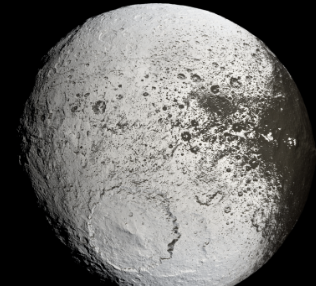
A split-faced world outside of Saturn, with a towering equatorial wall, frozen in time, and carved by forces we still don’t fully understand.
Thank you for reading this post, don’t forget to subscribe!Why It Matters
- Iapetus proves that surface-driven processes alone can transform an entire world without active geology.
- The equatorial ridge signals a formation pathway that current planetary models cannot fully explain.
- Its frozen shape and ancient surface preserve a direct record of early solar system conditions.
Iapetus does not ease you into its strangeness. It confronts you with it. One hemisphere is as dark as charcoal, absorbing nearly all the sunlight that reaches it. The other reflects light back into space, bright and icy, almost pristine.

Iapetus, Voyager 1 (Nov. 12, 1980), NASA/JPL, Public Domain.
The boundary between them is sharp and abrupt, creating the impression of two different worlds fused together. It is not a gradual transition. It is a divide that feels engineered by physics but looks almost deliberate.
According to NASA, the contrast on Iapetus is driven primarily by a process called thermal segregation. Dark material on the surface absorbs more sunlight and becomes significantly warmer than surrounding ice. This heat causes volatile ices within the darker regions to sublimate, turning directly into vapor and migrating away from warmer areas.
That vapor moves to the colder, brighter areas, where it freezes back into ice. Over time, this process pushes ice away from the warm, dark regions and builds it up on the colder, bright side, making the contrast between the two even stronger.

Illustration by DALL-E
Early observers saw Iapetus appear and disappear depending on its position. Even now, that behavior feels symbolic. This is a moon defined by imbalance, where visibility itself depends on which side is facing you. Check out the 3D map of Iapetus here: NASA | IAPETUS
The Wall That Encircles a World
Running along the equator is something that should not exist. If one were to visit, they would see a massive ridge rising up to about 12 miles (20 kilometers) high and stretching over 800 miles (1,300 kilometers), forming a continuous barrier that wraps around the moon like a seam. Observations from NASA’s Cassini mission highlight this feature as one of the most unusual structures in the Solar System, with no single agreed-upon explanation for how it formed.
It divides Iapetus physically and visually, reinforcing the sense that this world was shaped by forces outside the ordinary. Few structures anywhere in the solar system approach this scale relative to the size of the body they sit on. Its origin remains unresolved. One theory suggests Iapetus once had a ring system that collapsed onto its surface.

Iapetus global color map, NASA/JPL-Caltech/Space Science Institute/Lunar and Planetary Institute (Cassini mission), Public Domain.
Another proposes that the moon rotated rapidly in its youth, forcing material to pile along the equator before it slowed and froze in place. Each explanation carries implications that extend far beyond this single moon. Regardless of origin, the ridge gives Iapetus its unsettling geometry. It looks less like a natural satellite and more like a world that was altered mid-formation and left unfinished.
A World Frozen in Time
Iapetus is not perfectly round. It bulges and flattens in ways that reveal a past it never outgrew. Scientists believe it once spun much faster, stretching its shape outward. As it cooled, that shape became locked in place, preserving a moment from billions of years ago. Unlike other moons that resurfaced and evolved, Iapetus stopped. It kept its early form, holding onto its imperfections as permanent features.

Illustration created by DALL-E
Its surface is heavily cratered and largely unchanged, a quiet record of impacts and conditions from a distant era. There is little evidence of recent activity, no widespread reshaping, no signs of renewal. It is a world that formed, shifted, and then simply remained.
Isolation in the Darkness
Iapetus orbits far from Saturn at a steep inclination compared to the planet’s other major moons, placing it on the outer edge of the system. As noted in observations from the European Space Agency, (ESA) this distant and tilted orbit separates it from the stronger gravitational interactions and environmental forces that affect inner moons, allowing it to remain relatively undisturbed over time.

Illustration by DALL-E; approx. data from EBSCO
That isolation may explain both its preservation and its strangeness. It avoided the forces that would have erased its features, but it also remained exposed to external material that may have darkened its surface. It is both protected and influenced by its position, shaped by subtle processes over immense spans of time.
The Uneasy Conclusion
Iapetus does not violate physics, but it exposes the limits of current models. Its stark light–dark divide, global equatorial ridge, preserved bulged shape from a faster past rotation, and unusually tilted, distant orbit each point to different formation and evolutionary processes that should not coexist so cleanly in one object.
While each feature can be explained on its own, no single framework accounts for all of them together without gaps. That makes Iapetus a systems-level outlier, preserving multiple histories instead of resolving into one. Until a unified explanation can reconcile its surface, structure, shape, and orbit, it remains a clear signal that parts of the Solar System are still not fully understood.
#/media/File:Voyager_1_Iapetus.png)
#/media/File:Iapetus_Color_Map.jpg)
Leave a Reply