
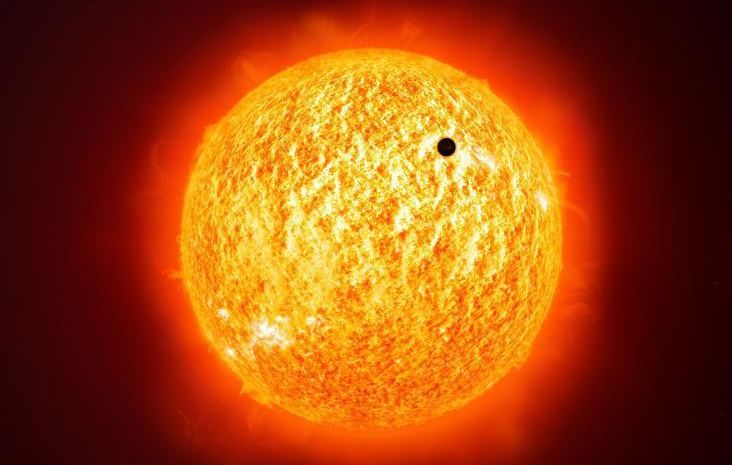
The Sun anchors the Solar System through gravity, powers it through nuclear fusion, and governs the motion, climate, and long-term stability of every object that orbits it.
Thank you for reading this post, don’t forget to subscribe!Why it Matters:
- The Sun’s gravity holds the Solar System together, preventing planets and smaller bodies from drifting into deep space.
- Its energy drives planetary climates, atmospheric chemistry, and the conditions necessary for life on Earth.
- Long-term changes in the Sun influence orbital stability, space weather, and the future evolution of the entire Solar System.
The Solar System exists because of one dominant mass. The Sun contains approximately 99.8% of all mass in the system, giving it gravitational control over planets, asteroids, comets, and dust. Every orbit is a response to that central well of gravity.

Illustration by Grok
Gravity decreases with the square of distance, yet even at Earth’s orbit, experts determine that the Sun exerts an acceleration of about 0.0059 meters per second squared. That small inward pull is sufficient to bend Earth’s forward motion into a stable ellipse. Remove it, and Earth would travel in a straight line into interstellar space.

Illustration by Grok
What is Happening at the Sun’s Core?
Inside the Sun’s core, hydrogen nuclei fuse into helium at temperatures near 15 million degrees Celsius. This process converts mass into energy, producing roughly 3.86 × 10²⁶ watts of power. Only a fraction reaches Earth, but that fraction drives atmospheric circulation, ocean currents, and surface temperatures.

Illustration by Grok
Solar radiation travels approximately 150 million kilometers in just over eight minutes. The energy arrives primarily as visible and infrared light, with smaller contributions from ultraviolet radiation and charged particles. Distance determines intensity, and intensity determines planetary climate.
| Quite the Distance The Sun is about 150 million kilometers (93 million miles) from Earth. If your average round trip to the grocery store is about 10 kilometers (6 miles), sunlight travels the equivalent of roughly 15 million grocery runs in just over eight minutes. That is the scale of the distance between us and the star that powers every cloud, current, and climate pattern on this planet. |
The Sun’s stability is not something astronomers casually assume. It is measured. In Sun Stability and Earth Orbit, published by Springer Nature, Gianpaolo Bellini explains how solar neutrino detections confirm that nuclear fusion in the Sun’s core has remained remarkably steady for at least 100,000 years.
Even more striking, the neutrino flux subtly rises and falls with Earth’s orbit, peaking near perihelion in early January and dipping near aphelion in July. The geometry of our orbit is written directly into the particle output of the core.

Orbiting Within the Sun
The Sun does not simply sit at the center of the Solar System. It rotates, drags its magnetic field outward, and pushes a continuous stream of charged particles into space as the solar wind. That outward flow carves out the heliosphere, a magnetic bubble that extends far beyond Pluto. Every planet, asteroid, and comet orbits inside this solar atmosphere. We do not orbit near the Sun. We orbit within it.
Magnetic activity adds texture to that stability. Solar flares and coronal mass ejections release concentrated bursts of energy and charged plasma that travel outward through interplanetary space. When those disturbances intersect Earth, they can disrupt satellites, interfere with radio communication, distort GPS signals, and overload power infrastructure. Space weather is not metaphorical. It is solar physics interacting directly with modern technology.
Recent observations have also shown that the Sun is not simply expelling material outward in a one-way flow. Scientists have identified plasma inflows in the corona, where previously ejected material can cool, fall back, and be reprocessed within the Sun’s magnetic structures. In that sense, the Sun exhibits a form of energy and mass recycling within its own atmosphere. Even in its eruptions, it remains a self-regulating, magnetically structured system rather than a chaotic fireball.
The Sun is about 4.6 billion years old, a G2 V main-sequence star still fusing hydrogen into helium in its core. It will continue doing so for roughly another five billion years before exhausting that fuel and expanding into a red giant. When that phase begins, the inner Solar System will be permanently reshaped. Planetary architecture is not eternal. It is contingent on stellar evolution.

Solar Flare Erupting from the Sun (June 20, 2013). Credit: NASA/SDO.
At the most fundamental level, the Sun does three things. Gravity organizes matter into orbit. Fusion converts mass into energy. Magnetism injects variability into an otherwise stable system. Remove any one of those and the Solar System as we know it ceases to exist.
The Sun looks steady from Earth. It rises, it sets, it appears constant. But beneath that familiarity is a thermonuclear engine whose gravity anchors worlds, whose photons regulate climate, and whose magnetic fields ripple across interplanetary space. Stability, in this context, is not stillness. It is controlled, measurable persistence across astronomical time.
Leave a Reply