
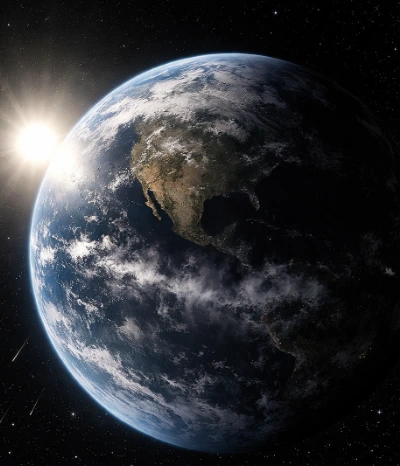
A step-by-step look at how pressure, temperature, radiation, and water would rapidly destabilize if Earth’s protective atmospheric system vanished.
Thank you for reading this post, don’t forget to subscribe!Why it Matters
- It explains why Earth can support life while airless worlds cannot.
- It shows how pressure, temperature control, and radiation shielding determine planetary habitability.
- It clarifies that without an atmosphere, Earth would quickly become hostile to complex life.
If Earth suddenly lost its atmosphere, the planet would not explode and it would not break apart. It would become immediately hostile to nearly all life. The transformation would be fast, physical, and governed entirely by pressure, radiation, and thermodynamics.
CK-12’s article “What Would Happen If There Was No Atmosphere?” explains that the atmosphere regulates temperature, filters harmful radiation, and maintains the pressure required for liquid water. Those are the structural systems that allow biology to function at the surface.
Immediate Biological Collapse
Without atmospheric pressure, oxygen would disappear instantly and blood oxygen levels would collapse within seconds. NASA confirms that unprotected humans would lose consciousness in roughly 10–15 seconds as breathable air vanishes. Bodily fluids would begin to boil at normal body temperature because low pressure lowers the boiling point of water.

You would not explode, but survival would be measured in seconds without a pressure suit. The atmosphere exerts constant force on the body, stabilizing fluids and dissolved gases. Remove that force and the physics of phase change takes over immediately.
The Sky Would Turn Black
The blue sky exists because atmospheric molecules scatter incoming sunlight. Remove the gas and the scattering effect disappears completely. Even at noon, the sky would appear black against the backdrop of space.

Astronauts observe this directly while in orbit. The sky’s color is not an intrinsic property of sunlight. It is the result of light interacting with air molecules suspended above the surface.
Temperature Extremes
Earth’s atmosphere absorbs, redistributes, and retains heat, creating relatively stable temperature ranges. Unacademy’s geography overview on the atmosphere outlines how atmospheric layers manage energy flow and moderate climate. Without this vertical structure, there would be no system to balance daytime heating and nighttime cooling.

Daytime temperatures would spike under direct solar radiation. Nighttime temperatures would plunge sharply once the Sun sets. Earth would begin behaving more like Mercury, where temperature swings exceed 1,000° Fahrenheit due to the absence of a substantial atmosphere.
Liquid Water Would Not Survive
Atmospheric pressure allows liquid water to remain stable at Earth’s surface. Without pressure, surface water would rapidly begin to boil. Oceans would evaporate into vapor, and that vapor would gradually escape into space.

The Geologists of Jackson Hole presentation, “Global Warming 101” by Mike Adler, explains how atmospheric composition controls heat retention and supports stable water cycles. Eliminate the gaseous envelope and the hydrologic cycle collapses entirely. Over time, Earth would resemble a dry and irradiated world rather than a water rich planet.
Radiation Exposure Would Spike
The atmosphere shields life from ultraviolet radiation, X-rays, and cosmic rays. Without that protective layer, radiation exposure at the surface would increase immediately. DNA damage would accumulate rapidly and complex life would collapse.

CK-12 emphasizes the importance of atmospheric filtering, while Vocal’s futurism article “Could Earth One Day Lose Its Atmosphere?” discusses long term atmospheric stripping scenarios and gravitational escape. Both reinforce that atmospheric shielding is fundamental to sustaining complex organisms. Remove the shield and biological systems are directly exposed to high energy solar output.
Sound Would Disappear
Sound requires a medium to travel. Without air molecules, pressure waves cannot propagate. Voices, wind, thunder, and aircraft noise would vanish instantly.

The planet would be silent except for vibrations transmitted through solid ground. Even communication as we understand it depends on atmospheric density. Without gas, acoustic energy has nowhere to travel.
Long Term Planetary Outcome
Over geological time, lighter gases would escape permanently into space. Surface chemistry would shift under constant radiation exposure. Volcanic outgassing could slowly release new gases and begin rebuilding an atmosphere.

Reconstructing an oxygen rich atmosphere like today’s would take millions of years of chemical cycling and biological feedback. Stability depends on continuous interaction between oceans, life, and atmospheric chemistry. Without those feedback systems, recovery would be slow and uncertain.
Leave a Reply