
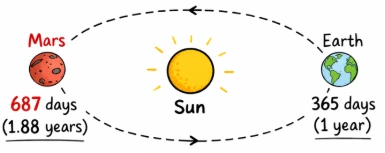
A clear explanation of the Martian year, orbital distance, speed, and how gravity determines seasonal length.
Thank you for reading this post, don’t forget to subscribe!Why it Matters:
- Understanding the length of a Martian year allows scientists to calculate spacecraft launch windows, surface mission timelines, and communication planning with precision.
- The duration of Mars’s orbit directly shapes its climate cycles, seasonal carbon dioxide ice formation, and global dust storm patterns.
- Comparing Mars’s year to Earth’s reveals how distance from the Sun governs orbital speed, seasonal length, and long-term planetary stability.
Mars takes 687 Earth days to complete one full orbit around the Sun. That equals about 1.88 Earth years, meaning a single year on Mars lasts nearly twice as long as a year on Earth. This extended orbital period sets the rhythm for everything from Martian weather cycles to the planning of robotic exploration missions.
| Feature | Mars | Earth |
| Orbit Duration (Days) | ~687 Earth days | ~365.25 days |
| Orbit Duration (Years) | ~1.88 Earth years | 1 Earth year |
| Precise Measurement | 686.98 days | 365.24 days |
| Impact | Extended seasons & mission cycles | Standard seasonal cycles |
Astronomers refine the number even further to approximately 686.98 Earth days, which is rounded to 687 for simplicity. That precision comes from long-term orbital tracking and spacecraft data. The consistency of these measurements confirms that Mars’s longer year is a stable and predictable feature of its motion.
Distance Determines Time
The primary reason Mars has a longer year is distance. On average, NASA has explained that Mars orbits about 142 million miles (228 million kilometers) from the Sun, while Earth orbits at about 93 million miles. The greater the orbital radius, the larger the path a planet must travel.

A larger orbital path naturally requires more time to complete. Even if Mars moved at the same speed as Earth, the added distance alone would lengthen its year. However, Mars also moves more slowly, which extends its orbital period even further.
Orbital Speed and Gravity
Mars travels at roughly 15 miles per second (24 kilometers per second) as it circles the Sun. Earth, by comparison, moves at about 18.5 miles per second (30 kilometers per second). This difference in speed is not random but dictated by gravity.

According to Kepler’s Third Law of Planetary Motion, planets farther from the Sun move more slowly because the Sun’s gravitational pull weakens with distance. Weaker gravitational force means lower orbital velocity. When distance increases and speed decreases, the result is a longer orbital period.
The Shape of Mars’s Orbit
Mars does not follow a perfectly circular orbit. Instead, it travels along a slightly elliptical path that changes its distance from the Sun throughout the year. At perihelion, its closest approach, Mars is about 128 million miles from the Sun, and at aphelion, its farthest point, it reaches roughly 155 million miles.

This variation influences seasonal intensity. When Mars is closer to the Sun, solar energy increases, making southern hemisphere summers shorter but warmer. When it is farther away, northern hemisphere summers become longer and milder.
Seasons That Last Nearly Twice as Long
Mars has an axial tilt of about 25 degrees, which is very close to Earth’s 23.5-degree tilt. That tilt allows sunlight to shift between hemispheres over the course of its orbit, creating seasons similar in structure to those on Earth. However, because the Martian year is nearly twice as long, each season lasts significantly longer.

These extended seasons drive large-scale environmental changes. Carbon dioxide at the poles freezes into ice during winter and sublimates back into the atmosphere during summer. Global dust storms can also develop and evolve over long seasonal cycles that stretch across many Earth months.
Measuring the Martian Orbit
Scientists determine Mars’s orbital period by tracking its motion against distant background stars and applying gravitational models. Modern spacecraft orbiting Mars provide additional precision through telemetry and long-term observation. These combined methods confirm that Mars completes one revolution in just under 687 Earth days.
The orbital period is not an abstract statistic. It reflects the balance of gravitational force, momentum, and distance within the Solar System. Mars’s nearly two-year-long orbit is a direct consequence of the physical laws that govern all planetary motion.
Mars’s extended year is more than a calendar difference. It is evidence of how structure, gravity, and distance shape the environments of worlds across the Solar System. Understanding that structure brings clarity to how our planetary neighborhood functions as an interconnected system.
Leave a Reply