
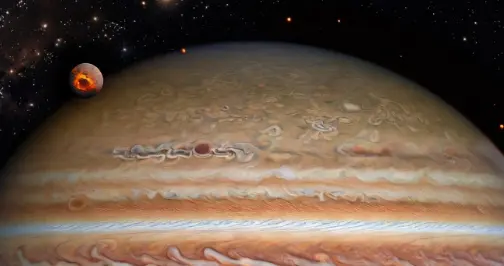
A look at how Jupiter’s powerful gravity, intense radiation belts, and violently active moons create one of the most hazardous environments anywhere in the Solar System.
Thank you for reading this post, don’t forget to subscribe!Why it Matters:
- Jupiter’s moons matter because their extreme volcanic activity, intense radiation, and powerful gravitational forces reveal the formation of dangerous environments.
- Studying these moons helps scientists understand how tidal forces and radiation from massive planets can dramatically reshape nearby worlds.
- Understanding Jupiter’s moon system helps researchers predict how similar planetary systems may behave around gas giants across the universe.
If the Solar System has a most dangerous neighborhood, it lies deep inside the orbit of Jupiter. Dozens of moons circle this giant planet through intense gravity and powerful radiation that can destroy spacecraft electronics and strip away unprotected surfaces. More than 90 moons are known to orbit Jupiter, and many exist in environments that push planetary physics to its limits.

Illustration of Jupiter and it’s many moons by DALL-E
Four of these worlds dominate the system. They are the Galilean moons: Io, Europa, Ganymede, and Callisto. Each behaves more like a small planet than a typical moon and operates under extreme conditions shaped by Jupiter’s immense gravitational pull. One world is the most volcanically active place known. Another hides a vast global ocean beneath miles of ice. One is the largest moon in the Solar System and even generates its own magnetic field.

Illustration of the four largest moons of Jupiter; image from Starwalk Space
Together, these moons create one of the most violent and scientifically fascinating regions in space. They are dangerous, unstable, and constantly reshaped by powerful forces, yet they are also some of the most important worlds scientists study when searching for alien oceans and potentially habitable environments beyond Earth. Let’s take a quick look at the four largest moons of Jupiter.
Io: The Solar System’s Volcano Factory
Io is widely recognized as the most volcanically active world in the Solar System. According to NASA, more than 400 active volcanoes have been identified across its surface. The moon’s landscape is constantly resurfaced by lava flows, sulfur deposits, and massive eruption plumes.
The source of this extreme activity is a process known as tidal heating. As Io orbits the giant planet Jupiter, the planet’s immense gravity continuously pulls and stretches the moon. Additional gravitational tugs from neighboring moons such as Europa and Ganymede keep Io’s orbit slightly elliptical, which prevents the moon from settling into a stable shape.

Image data: NASA/JPL-Caltech / SwRI / MSSS. Image processing by Emma Wălimäki. CC BY.
This constant gravitational squeezing flexes Io’s interior and generates enormous amounts of heat. NASA scientists explain that the process melts large portions of rock beneath the surface, creating a global system of magma chambers that feed continuous volcanic eruptions.
Some of Io’s eruptions are among the most powerful known in planetary science. Observations from NASA’s Galileo spacecraft and later missions have recorded volcanic plumes rising 300 to 500 kilometers above the surface. Lava temperatures can exceed 2,400°F (about 1,300°C), rivaling the hottest eruptions seen on Earth.

Illustration of Io’s volcanic activity by DALL-E
The result is a world unlike any other moon. Io’s surface is coated in sulfur and sulfur dioxide frost that produces its distinctive yellow, orange, red, and black colors. Because lava flows and eruptions constantly reshape the terrain, impact craters are rare. Older features are quickly buried beneath new volcanic deposits.
Europa: The Ocean World
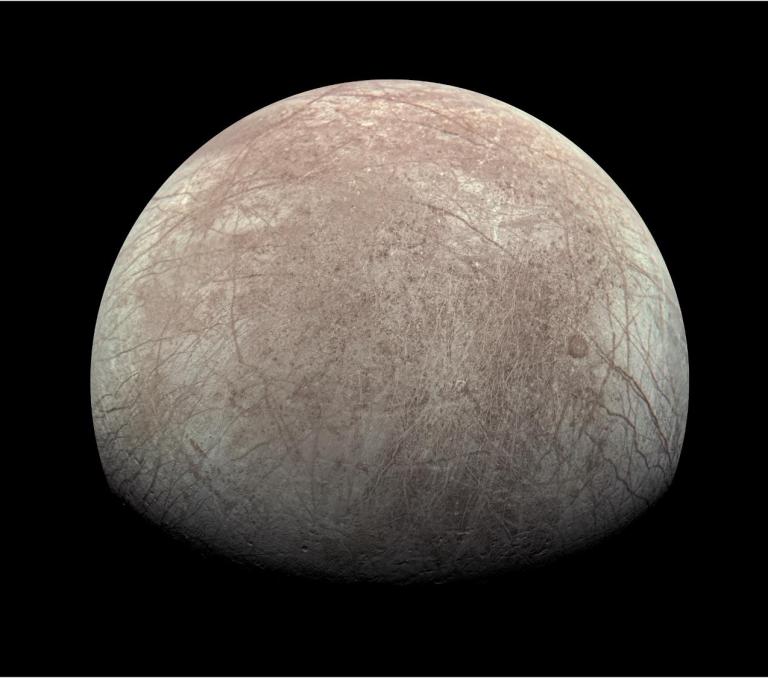
Europa appears calm and frozen when viewed from space. Its bright surface is covered by a thick shell of ice crossed by long dark fractures called lineae. These cracks stretch for thousands of kilometers and record the stresses created as the moon flexes under the powerful gravity of Jupiter.

Image credit: NASA/JPL-Caltech/SwRI/MSSS, processed by Kevin M. Gill (CC BY 3.0).
Beneath that frozen exterior, scientists believe Europa hides one of the largest oceans in the Solar System. Research supported by NASA suggests that a global saltwater ocean exists under the ice and may contain more water than all of Earth’s oceans combined. Estimates indicate the outer ice shell could be several miles thick, while the ocean below may extend 60 to 100 miles deep in some regions.

Illustration of Europa’s interior by DALL-E
Like neighboring moons in Jupiter’s system, Europa is heated by tidal forces. As the moon moves through its orbit, Jupiter’s immense gravity constantly squeezes and stretches Europa’s interior. According to scientists at the Jet Propulsion Laboratory, this tidal heating likely generates enough internal energy to keep the subsurface ocean from freezing solid.
These conditions have made Europa one of the most compelling places in the Solar System to search for life. Liquid water, internal heat, and potential chemical nutrients could create an environment similar to deep ocean ecosystems on Earth.

Illustration of Europa Clipper spacecraft by DALL-E
To investigate this possibility, NASA is preparing the Europa Clipper spacecraft. The mission will perform dozens of close flybys of Europa, mapping the ice shell, measuring the thickness of the crust, and searching for signs that ocean water may be rising toward the surface through fractures in the ice.
Ganymede: The Giant Moon
Ganymede is the largest moon in the Solar System. It measures about 3,273 miles (5,268 km) in diameter, making it larger than the planet Mercury. If Ganymede orbited the Sun instead of Jupiter, it would likely be classified as a planet rather than a moon.

Image credit: NASA / NASA-JPL Galileo spacecraft view of Ganymede, June 26, 1996.
One of the most unusual features of Ganymede is that it possesses its own magnetic field. NASA explains that this magnetic field is produced by motion within a liquid metallic core deep inside the moon. It is the only known moon in the Solar System with a self-generated magnetosphere, which creates miniature auroras above its icy surface.

Illustration of Ganymede’s magnetic field by DALL-E
Ganymede’s surface tells a long geological story. Large regions of dark, heavily cratered terrain record some of the oldest surfaces in the Jovian system. These ancient areas are crossed by younger, brighter bands of grooved terrain that scientists believe formed when the crust fractured and shifted during tectonic activity billions of years ago.
Evidence also suggests that Ganymede may contain multiple layers of subsurface oceans trapped beneath its thick ice shell. Studies from NASA missions and modeling work by planetary scientists indicate that these oceans could be sandwiched between layers of high-pressure ice deep below the surface.
Callisto: The Ancient Survivor
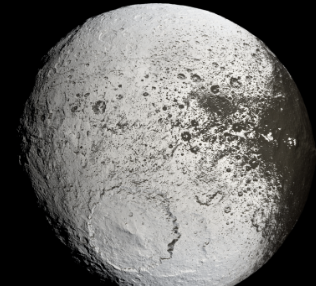
Callisto is one of the most heavily cratered worlds in the Solar System. Its battered surface preserves a record of impacts stretching back billions of years, making it a frozen archive of early Solar System history. Unlike many other moons, large regions of Callisto’s terrain have remained largely unchanged since the era of intense bombardment that followed planetary formation.

Image credit: NASA/JPL. View of Callisto captured by the Galileo spacecraft.
This ancient appearance exists because Callisto experiences relatively weak internal activity. Compared with neighboring moons such as Io and Europa, the moon undergoes far less tidal heating from the gravity of Jupiter. NASA notes that the moon’s extremely low internal heat means there are very few geological processes capable of resurfacing its terrain or erasing impact craters.
Callisto also orbits farther from Jupiter than the other large Galilean moons. Because of this distance, it sits outside the most intense regions of Jupiter’s powerful radiation belts. Scientists at Jet Propulsion Laboratory have noted that this lower radiation environment makes Callisto one of the safer locations in the Jovian system for future exploration.

Demonstration of Callisto’s distance in orbit by DALL-E
For that reason, some mission planners have proposed Callisto as a potential staging location for a future human research outpost. From such a base, spacecraft could operate deeper within Jupiter’s dangerous moon system while keeping astronauts outside the most hazardous radiation zones.
What If Civilization Lived There?
Imagine building a civilization inside Jupiter’s moon system. The sky would never look calm for long. Jupiter itself would dominate the horizon, appearing dozens of times larger than Earth’s Moon and filling the sky with swirling bands of clouds and lightning storms.
Life near these moons would mean living beside constant planetary violence. On Io, the ground would regularly tear open as volcanoes hurled molten rock hundreds of miles into space. Entire regions of the surface would be resurfaced again and again by lava and sulfur deposits.

Closer to Jupiter, radiation would be one of the greatest dangers. The planet’s magnetic field traps enormous numbers of charged particles that move at nearly the speed of light. Any civilization operating near the inner moons would need massive shielding just to protect electronics and human life.
Even travel between worlds would require careful planning. Jupiter’s gravity constantly pulls on its moons, subtly changing their shapes and heating their interiors. The same tidal forces that create volcanoes and oceans would also shape the daily reality of living there.
Yet that danger would also come with an extraordinary view of the universe. Ice oceans, glowing auroras, volcanic worlds, and the largest planet in the Solar System rising overhead every day. It would be one of the most dramatic places a civilization could ever exist, but surviving there would require understanding and respecting the powerful forces that make Jupiter’s moon system the most dangerous neighborhood in the Solar System.
Leave a Reply