
A look inside the enormous lightning storms, planet-spanning tempests, and atmospheric megastorms that make Saturn one of the most violent weather worlds in the Solar System.
Thank you for reading this post, don’t forget to subscribe!Why it Matters:
- Saturn’s megastorms can encircle the entire planet and unleash energy on a scale far beyond anything on Earth
- Lightning storms there are thousands of times more powerful than Earth’s, revealing extreme atmospheric physics
- These violent systems help scientists decode how gas giants form, evolve, and behave across the universe
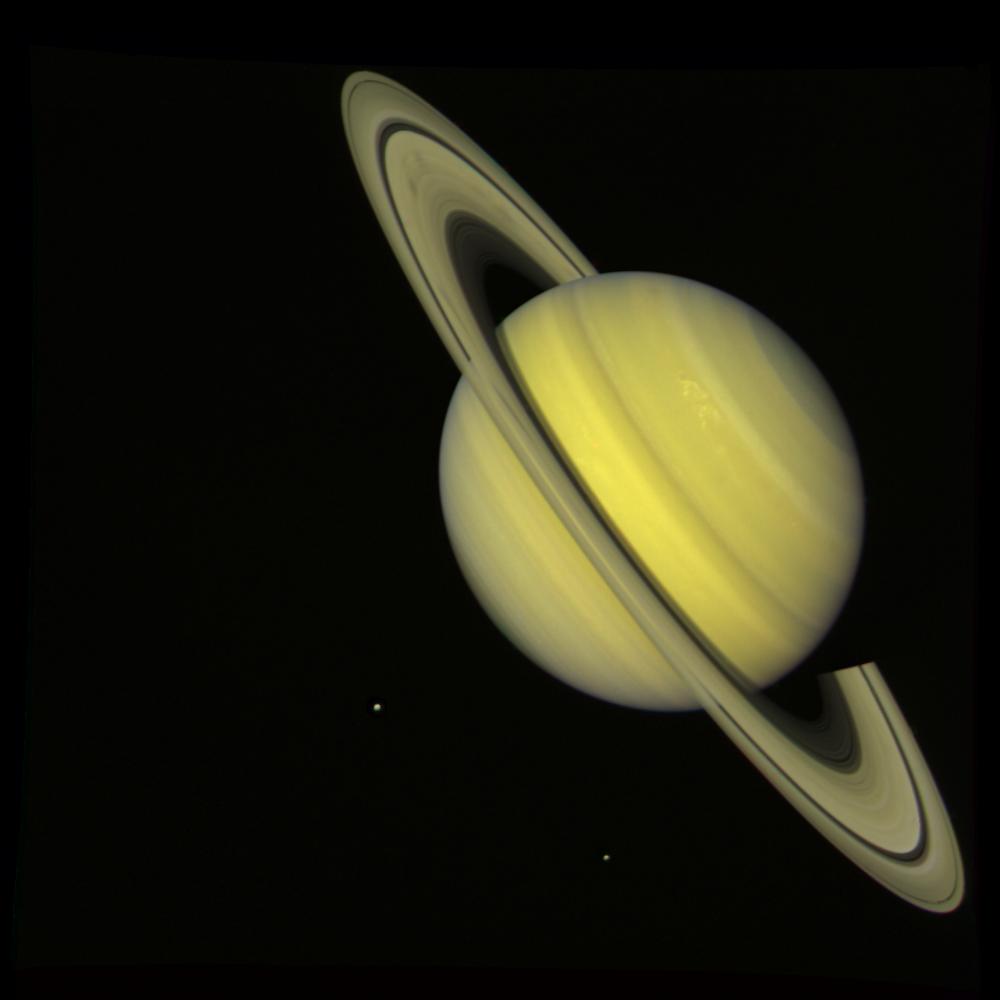
Saturn is often admired for its elegant rings and golden appearance, but beneath those serene visuals lies one of the most violent weather systems in the Solar System. The planet’s thick hydrogen and helium atmosphere generates storms that dwarf anything experienced on Earth. Some of these tempests grow so large that they wrap around the entire planet and release energy equivalent to thousands of nuclear explosions.

Image credit: NASA/JPL-Caltech/Space Science Institute.
Understanding Saturn’s storms helps scientists learn how gas giants function, how planetary atmospheres evolve, and why extreme weather behaves differently on worlds without solid surfaces.
Saturn’s Atmosphere: A Storm Factory
Saturn’s atmosphere is composed primarily of hydrogen and helium, with smaller amounts of methane, ammonia, and water vapor. These gases form layered cloud decks that move rapidly due to the planet’s fast rotation and intense internal heat.
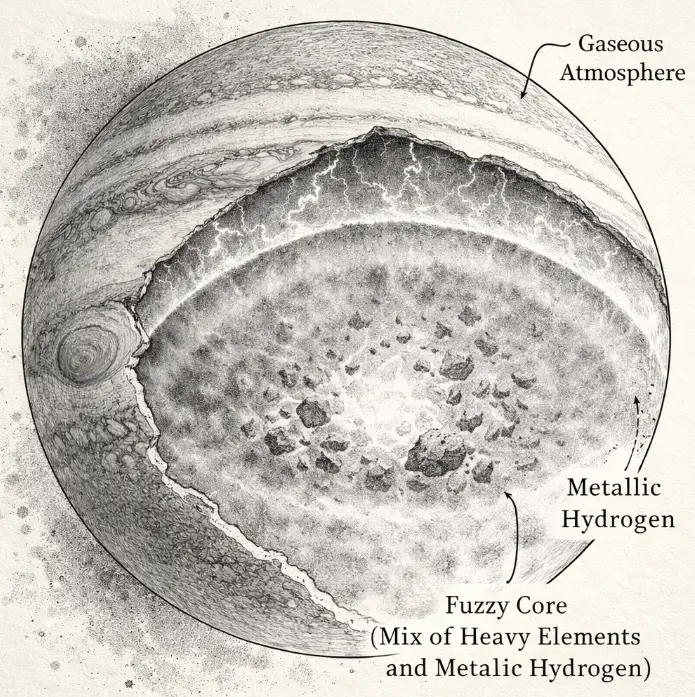
Unlike Earth, Saturn has no solid ground. Storm systems develop entirely within its deep atmosphere, where pressure and temperature increase dramatically with depth. Warm gases rise upward, cool gases sink downward, and the resulting circulation produces enormous convective storms.

Illustration of Saturn and its deep internal atmosphere by DALL-E
Wind speeds on Saturn can reach over 1,100 miles per hour, making them some of the fastest atmospheric currents anywhere in the Solar System. These winds help storms expand quickly and spread across huge regions of the planet.

Bands showing the layers of wind in the atmosphere by DALL-E
The powerful dynamics of Saturn’s atmosphere allow storms to grow to sizes far beyond what Earth’s weather systems could sustain.
The Great White Spots
One of the most dramatic storm phenomena on Saturn is known as the Great White Spot. These storms appear roughly once every Saturnian year, which equals about 29.5 Earth years.


Image credit: NASA/JPL-Caltech/Space Science Institute (PIA12824) Image credit: NASA/JPL-Caltech/SSI (Cassini) via Wikipedia.
When a Great White Spot forms, it erupts as a massive bright cloud system that can stretch tens of thousands of kilometers across the planet. Observations show that these storms can grow large enough to circle Saturn completely.

AI-generated illustration (ChatGPT/DALL·E).
The storms begin when heat trapped deep within the atmosphere suddenly rises upward. As warm gas rapidly ascends, it creates powerful thunderstorm activity and releases enormous energy into the surrounding atmosphere.
During the 2010–2011 Great White Spot, the storm expanded rapidly and wrapped around Saturn’s northern hemisphere. The disturbance altered atmospheric circulation patterns for months and generated massive lightning storms detectable from space.
NASA | Saturn’s Record-Setting Storm
These rare storms provide scientists with a unique opportunity to observe large-scale atmospheric processes in action.
Lightning on a Planetary Scale
Lightning inside Saturn’s storms is extraordinarily powerful. Observations from spacecraft have revealed electrical discharges thousands of times stronger than typical lightning bolts on Earth.

Image credit: NASA/JPL-Caltech/Space Science Institute (Cassini spacecraft).
These lightning events are believed to originate deep within Saturn’s water cloud layer. As rising gases create turbulence, ice particles and water droplets collide and generate massive electrical charges. When the charge difference becomes strong enough, lightning erupts through the surrounding clouds. The flashes are so intense that they can illuminate entire storm systems.
| Hear Saturn’s LightningExperience what storms on Saturn actually sound like. NASA converted radio waves from lightning into audio, revealing an eerie, crackling storm unlike anything on Earth. Explore and listen here: Lightning Sounds from Saturn |
Instruments aboard spacecraft have detected radio emissions from Saturn’s lightning storms. These signals can travel across millions of kilometers of space and allow scientists to monitor storm activity even when clouds obscure the flashes themselves.

The energy involved in these storms demonstrates just how powerful atmospheric convection can become on giant planets.
Megastorms That Shape the Atmosphere
Saturn occasionally experiences storms so large they are classified as megastorms. These events can dramatically alter the planet’s atmospheric structure and chemistry.

Image credit: NASA/JPL-Caltech/Space Science Institute.
Megastorms release enormous amounts of heat and energy, stirring gases from deep layers upward into higher altitudes. This vertical mixing changes the composition of the atmosphere and can leave chemical signatures detectable long after the storm fades.
Scientists have found evidence that megastorms may occur every few decades. When they do appear, they reshape atmospheric circulation patterns and generate disturbances that persist for years.
| Saturn’s Great White Spots (Planet-encircling super-storms recurring roughly every 29–30 Earth years) – 1876 — Equatorial zone; discovered by Asaph Hall – 1903 — Mid-northern latitudes; discovered by E.E. Barnard – 1933 — Equatorial zone; discovered by Will Hay – 1960 — High northern latitudes; discovered by J.H. Botham – 1990 — Equatorial zone; discovered September 24 by amateurs (Stuart Wilber & others) – 2010–2011 — Northern mid-latitudes; first seen December 5 by amateurs (Anthony Wesley & others); best-observed event (Cassini spacecraft) – Current status (March 2026)No new Great White Spot since 2011. Next likely window: southern hemisphere after ~2032 when the south pole tilts toward the Sun. Smaller storms happen in between, but only these six are the confirmed major periodic super-storms. |
These storms also produce vast shock waves that ripple across the atmosphere, disrupting cloud layers and spreading turbulence across entire hemispheres. Studying megastorms helps researchers understand how giant planets transport energy from their interiors into space.
The Mysterious Hexagon and Polar Storms
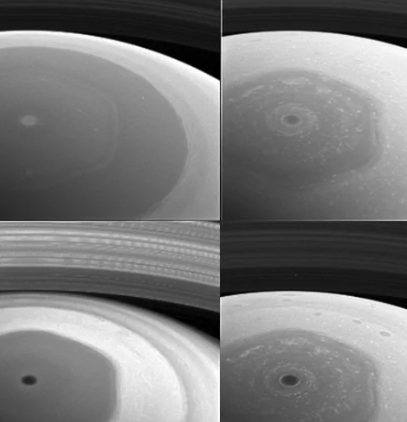
At Saturn’s north pole lies one of the most unusual atmospheric structures ever discovered: a massive hexagon-shaped jet stream. First observed by the Voyager spacecraft and later studied in detail by the Cassini mission, the hexagon is a six-sided storm pattern roughly 30,000 kilometers wide. That distance is large enough for four Earths to fit inside the structure.

Image credit: NASA / JPL-Caltech / Space Science Institute. Cassini spacecraft wide-angle natural-color image of Saturn’s north polar hexagon, July 22, 2013.
The hexagon is created by high-speed winds moving along a stable atmospheric boundary. Instead of forming a circular vortex, the jet stream organizes itself into a geometric wave pattern that maintains its six-sided shape.
At the center of the hexagon sits a massive polar hurricane with a clearly defined eye wall. Winds within this vortex can exceed 300 miles per hour, creating a powerful cyclone unlike anything on Earth. The stability of the hexagon remains one of Saturn’s most fascinating atmospheric mysteries.
Why Saturn’s Storms Matter
Studying Saturn’s storms does more than reveal dramatic weather patterns. These events help scientists understand how atmospheres behave on planets very different from Earth.
Key insights include:
• How heat from a planet’s interior drives atmospheric circulation
• How lightning forms in hydrogen-rich environments
• How storms mix gases and reshape atmospheric chemistry
• How large-scale jet streams create unusual geometric patterns
These discoveries also help astronomers interpret atmospheric behavior on exoplanets, many of which are gas giants similar to Saturn. By studying Saturn’s storms, researchers gain a better understanding of weather systems throughout the universe.
Leave a Reply