
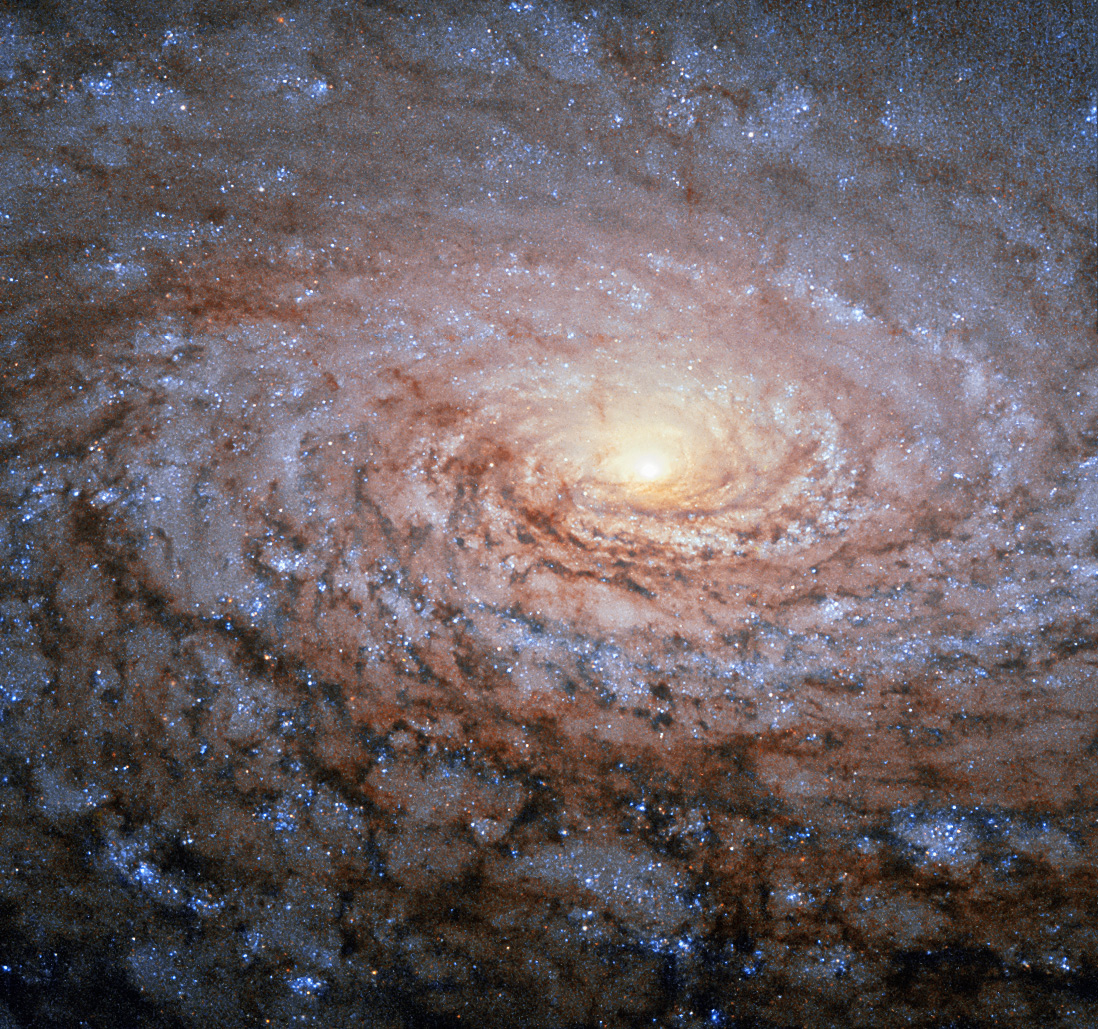
A study of 136 nearby galaxies found a gap between what stars and gas imply and what several models predict.
Thank you for reading this post, don’t forget to subscribe!
How to Weigh Something You Can’t See
A Hubble photo shows where stars shine. To estimate invisible mass, astronomers look at how stars and gas move under gravity, then model the contributions of visible matter and dark matter. In the Nov. 26 Nature Astronomy study, Yu Lei and colleagues applied a consistent method to 136 nearby galaxies spanning a broad range of stellar masses. Stellar motions provided information about the inner parts, while measurements involving neutral hydrogen helped constrain the outer regions.
Where the Simulations Diverged
The researchers report that the inferred dark matter density falls below the predictions of several simulations in the inner parts of their galaxies. The region over which the mismatch appears tends to reach farther out in galaxies with more stellar mass. The authors also checked whether selecting simulated galaxies of similar mass and size would eliminate the difference. In their analysis, it did not.
What Might Move Dark Matter Around?
Gravity responds to ordinary matter too. If gas collects near the center of a galaxy it can pull dark matter inward. Energetic processes that drive gas back outward can change how matter is distributed. Simulations must approximate some of those processes, and the authors say the origin of the observed discrepancy is still unclear. Their result offers a way to test how those assumptions affect the outcome.
What This Study Does Not Show
The authors did not directly image dark matter or find that these galaxies lack it altogether. They inferred a distribution by fitting observations, and then compared that distribution with model predictions. The familiar spiral pictured here, Messier 63, is an archival Hubble view for illustration; its stars are visible, but the image itself does not display the dark matter estimate or verify the study’s sample membership.
Sources
Yu Lei and colleagues, Nature Astronomy, published Nov. 26
ESA/Hubble’s archival Messier 63 image
Leave a Reply