
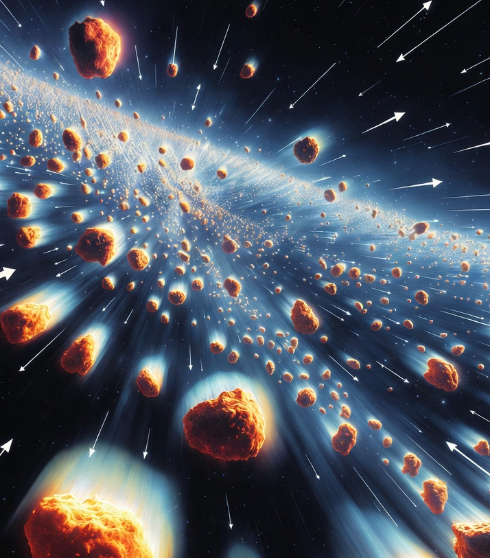
A slow, thermal recoil effect caused by uneven heating and cooling that gradually shifts an asteroid’s orbit over time.
Thank you for reading this post, don’t forget to subscribe!Why it Matters:
- Improves long-term asteroid trajectory predictions by accounting for tiny but cumulative thermal forces.
- Strengthens planetary defense calculations by refining impact probability models.
- Explains how small asteroids gradually migrate across the solar system over time.
If I handed you a flashlight and a rock, you would not expect orbital mechanics to enter the conversation.
But in space, sunlight is not just light. It is pressure. It is heat. And, over time, it is motion.
Harvard describes the Yarkovsky Effect is the quiet force that nudges asteroids off their predicted paths. When sunlight strikes a rotating asteroid, its surface heats up during the day. As that asteroid turns into night, it cools. Cooling means releasing that stored heat back into space as infrared radiation. That radiation carries momentum. Momentum creates thrust. The thrust is tiny, but it is real.

AI image by ChatGPT, 2026
Think of it as a microscopic thruster firing every rotation.
Over decades, the effect is measurable. Over millions to billions of years, it can reorganize the asteroid belt itself. Scientists have mathematically modeled this “thermal recoil” as a nongravitational acceleration produced by anisotropic infrared emission, and shown that it is especially effective on small bodies, particularly those under roughly 30–40 kilometers in diameter.
Because the force is continuous and accumulates quadratically with time in orbit determination models, even a minute acceleration can translate into substantial semimajor axis drift.

AI image by ChatGPT, 2026
According to D. Vokrouhlický, A. Milani, and S. R. Chesley in Icarus, precise radar astrometry over multiple apparitions is required to detect this slow drift, but the predictions indicate that kilometer-scale near-Earth asteroids can experience measurable changes in their orbital elements over decadal time spans.

AI image by ChatGPT, 2026
Over geological timescales, this drift acts as a delivery mechanism, moving fragments from the main belt into resonances that inject them into near-Earth space. The same process contributes to the gradual dispersal and dynamical aging of asteroid families, helping explain how clusters spread apart long after their original collisional formation.
This matters for us.
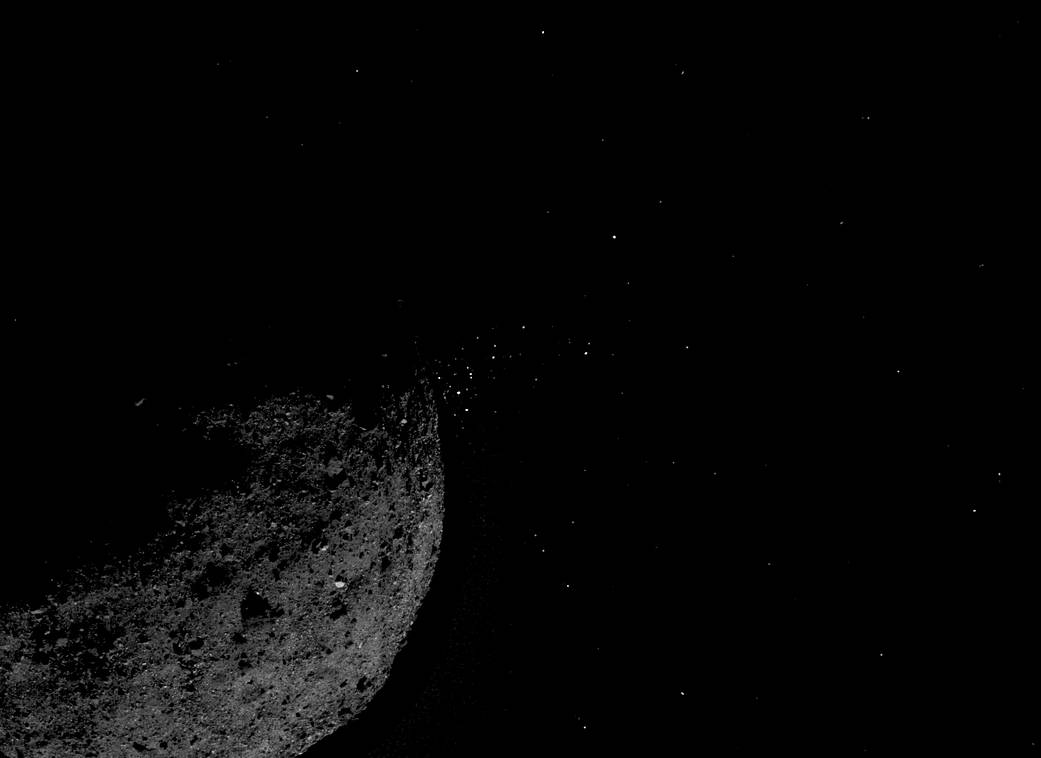
Near-Earth asteroids like Bennu have orbits that must be predicted with extreme precision. But because the Yarkovsky effect accumulates over time, even small modeling errors can grow into large uncertainties. Radar observations across multiple close approaches allow scientists to detect this drift. In fact, long time spans between measurements are critical, because the effect compounds quadratically with time.

Image Credit: NASA OSIRIS-REx mission, Asteroid Bennu
NASA’s OSIRIS-REx mission was not just about grabbing a sample from Bennu. It also helped refine our understanding of how an asteroid’s shape, spin, brightness, and surface texture affect the way it absorbs and re-emits sunlight. Those details directly influence the strength and direction of the Yarkovsky push.
Video: NASA YouTube
There is also a rotational cousin to this effect: the YORP effect. While Yarkovsky changes orbits, YORP alters spin rates and tilt. Together, these sunlight-driven forces quietly sculpt the small bodies of our Solar System.
| What is the YORP effect? The YORP effect stands for Yarkovsky–O’Keefe–Radzievskii–Paddack effect. It is a torque caused by sunlight that changes the rotation of small bodies in space. When sunlight hits an irregularly shaped asteroid, part of that energy is reflected and part is absorbed and later re-emitted as infrared radiation. Because the surface is uneven, the radiation does not leave uniformly. That uneven emission produces a tiny torque. Over time, this torque can: – Speed up or slow down an asteroid’s spin – Change its rotation axis – Reshape the asteroid In extreme cases, spin it so fast that it breaks apart. The YORP effect affects rotation, while the Yarkovsky effect affects orbital motion. Both are caused by solar radiation acting over long periods of time, and both are strongest on small asteroids. |
Between Yarkovsky and YORP, sunlight is not passive. It alters motion and rotation in ways that compound over time. One changes an asteroid’s orbit. The other changes its spin. Both operate slowly, but both are persistent.
Sunlight looks gentle. In space, given enough time, it moves worlds.
Leave a Reply